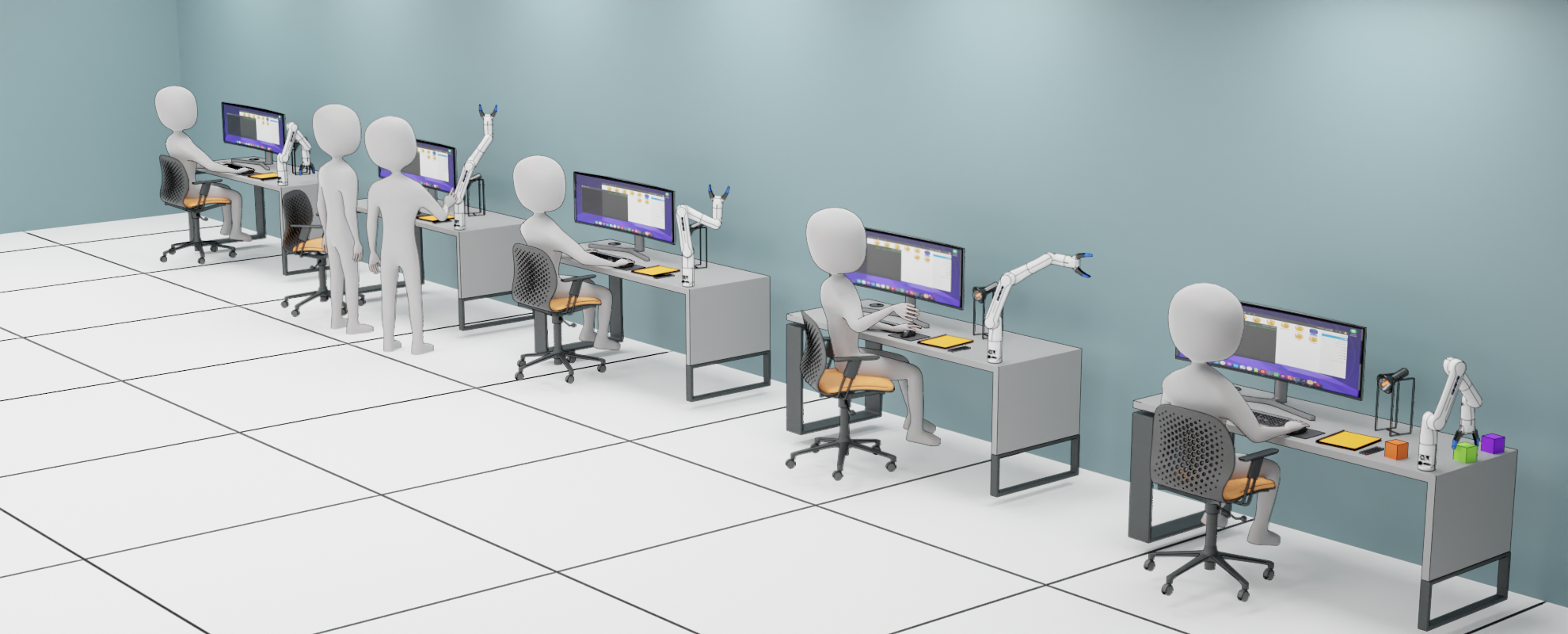
Applied Planning, Learning, and Optimization (APOLLO) Lab
We develop the computational foundations for robots that can update their understanding, actions, and skills as the world changes. Our research brings together perception, planning, learning, and optimization to make adaptation practical within the time and computation available during operation.
We pursue this goal through connected work on understanding a changing world, acting reliably and responsively, and learning from experience.
Understanding, action, and learning together
Research Questions
How can a robot understand an unfamiliar situation quickly enough to act?
Explore this question 2. ActHow can robots act reliably and respond quickly as conditions change?
Explore this question 3. LearnHow can a robot use ongoing experience to improve its behavior?
Explore this questionWe connect these questions through efficient computation: exploiting geometry, reusing information, and learning from experience. Our mathematical methods and software tools help make adaptation practical.
Explore our research agendaResearch in action
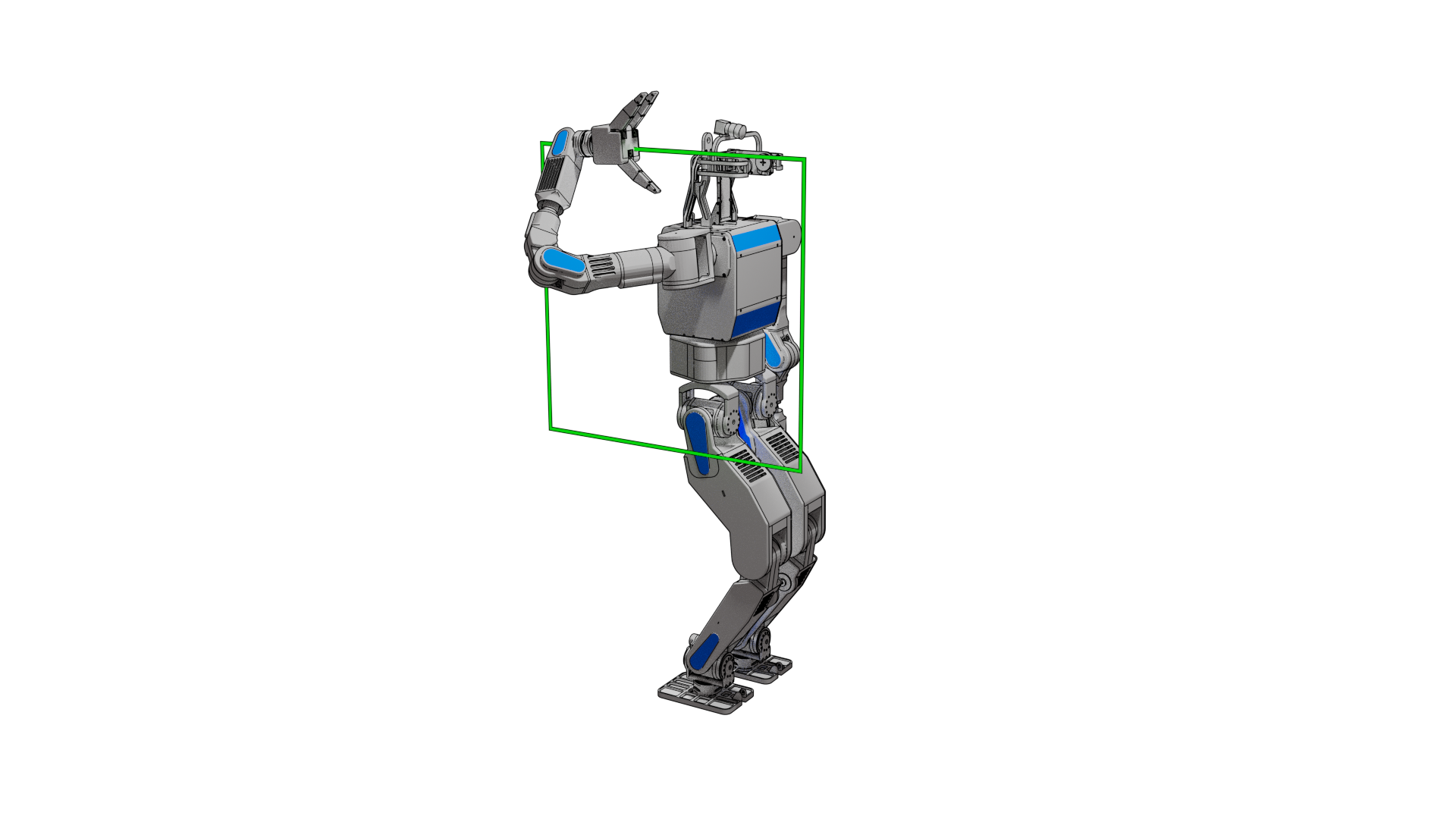
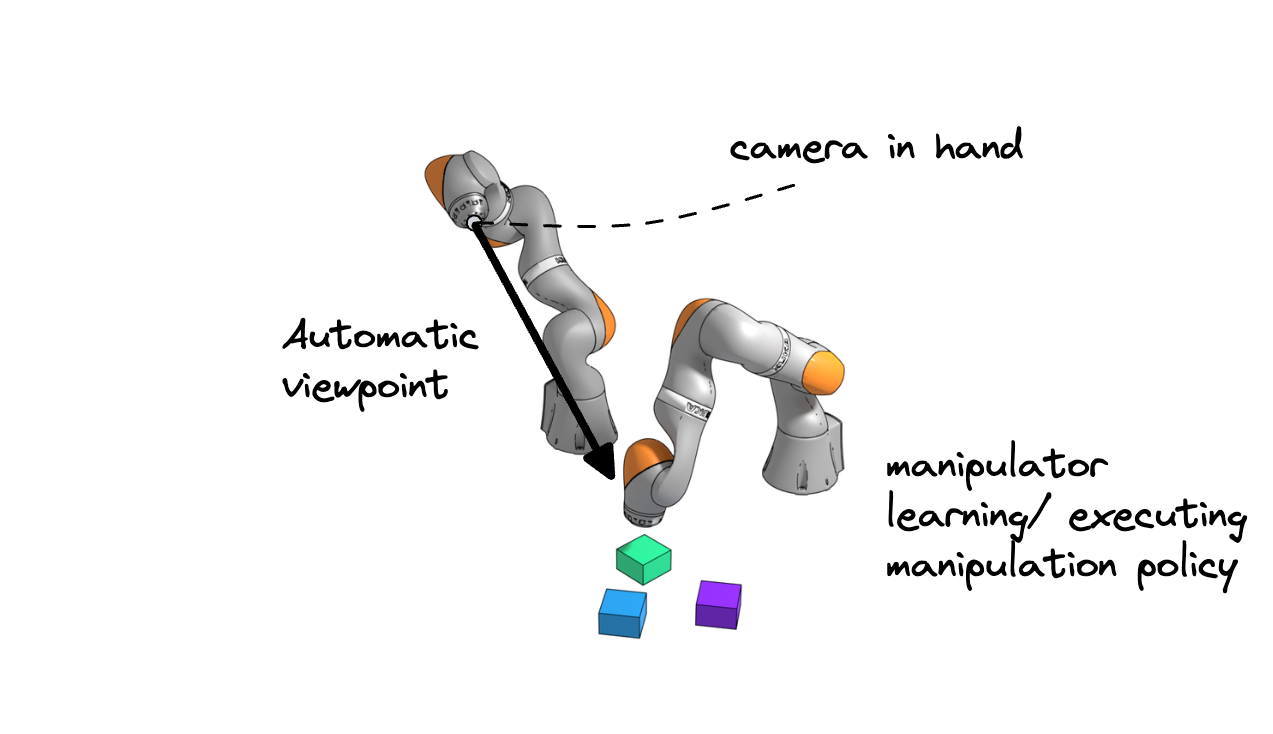
Lab Space
Recent News
APOLLO Lab at IROS
October 4, 2026
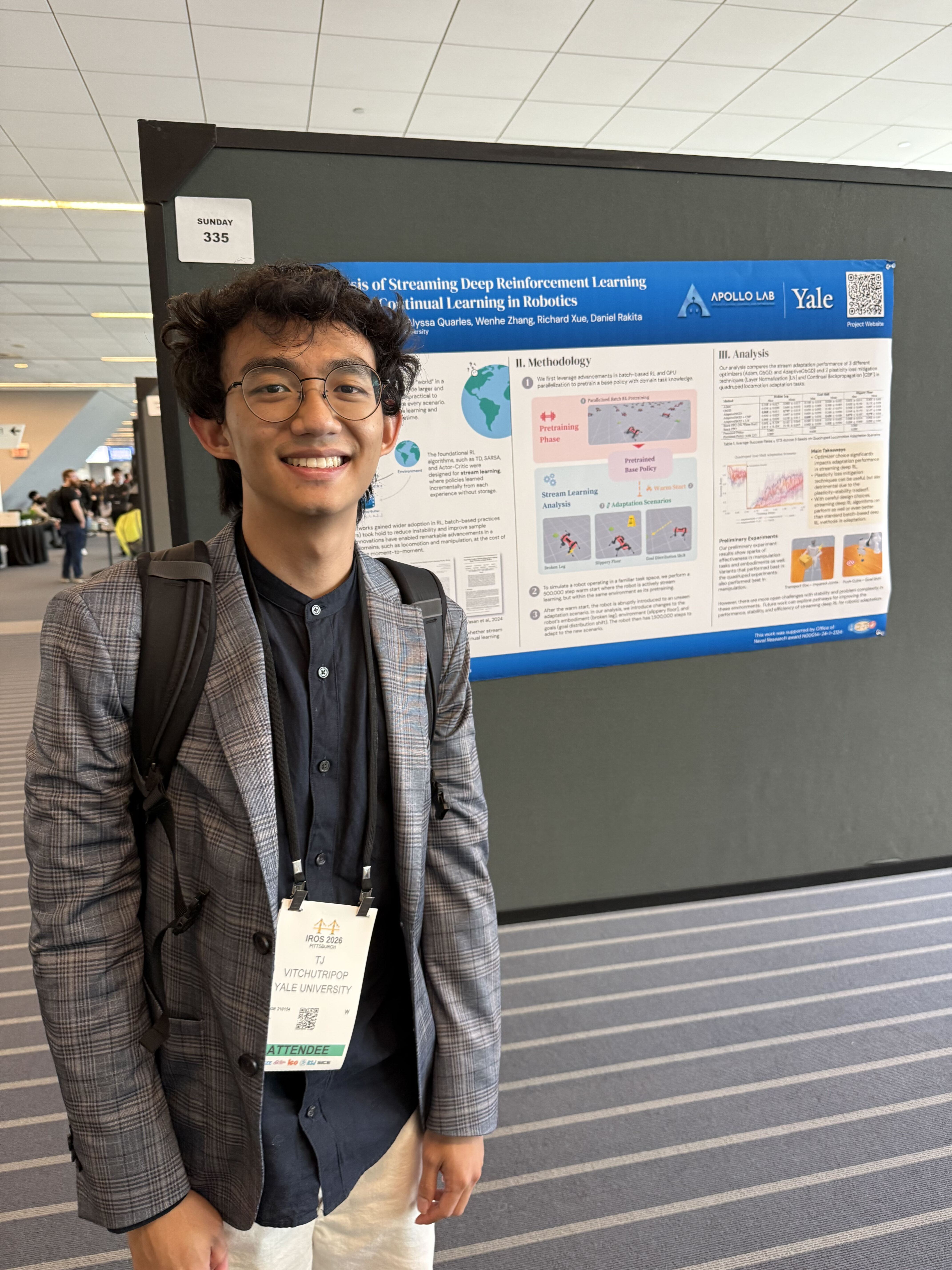
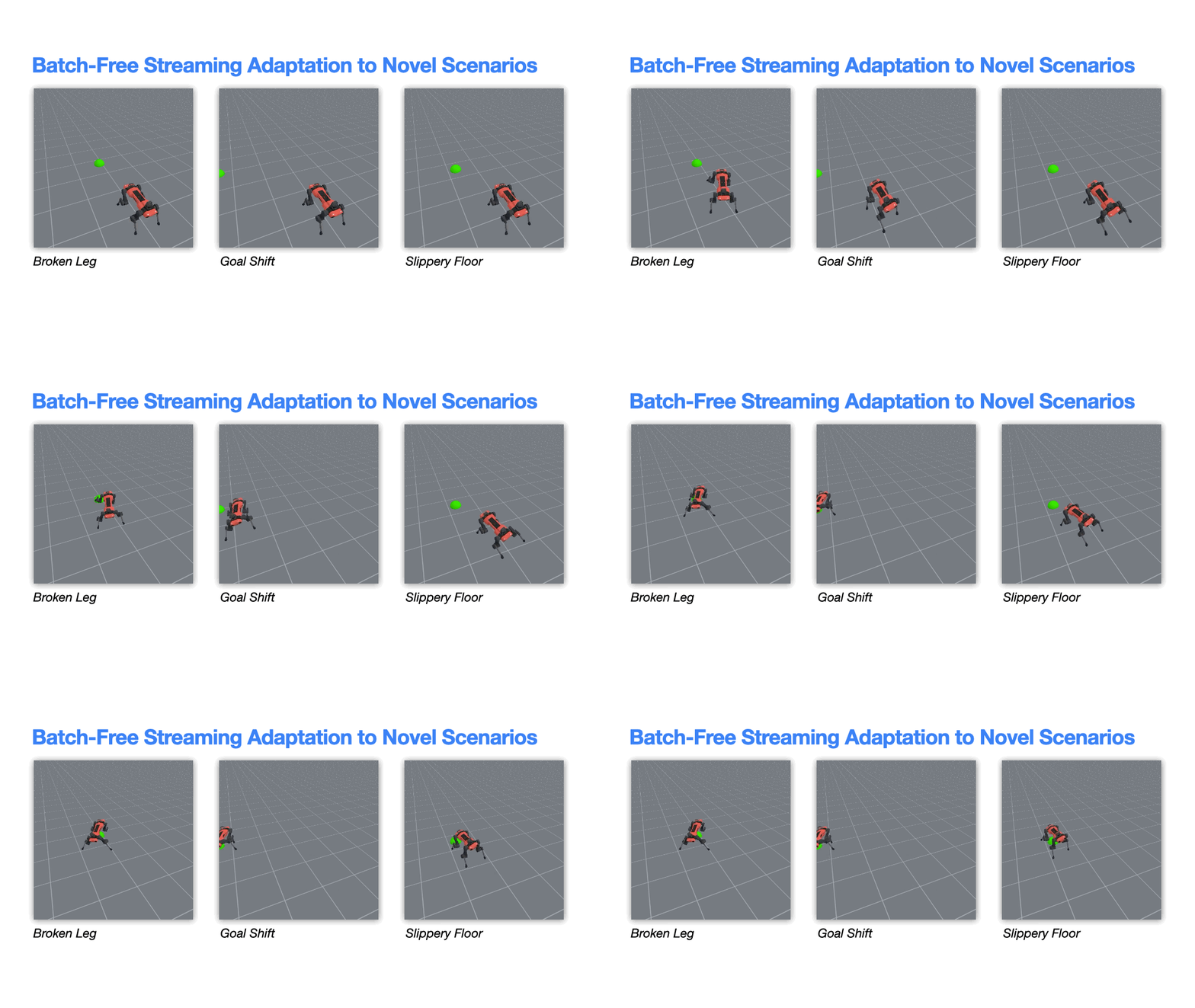
TJ Vitchutripop with the streaming reinforcement learning poster at the LTP workshop.
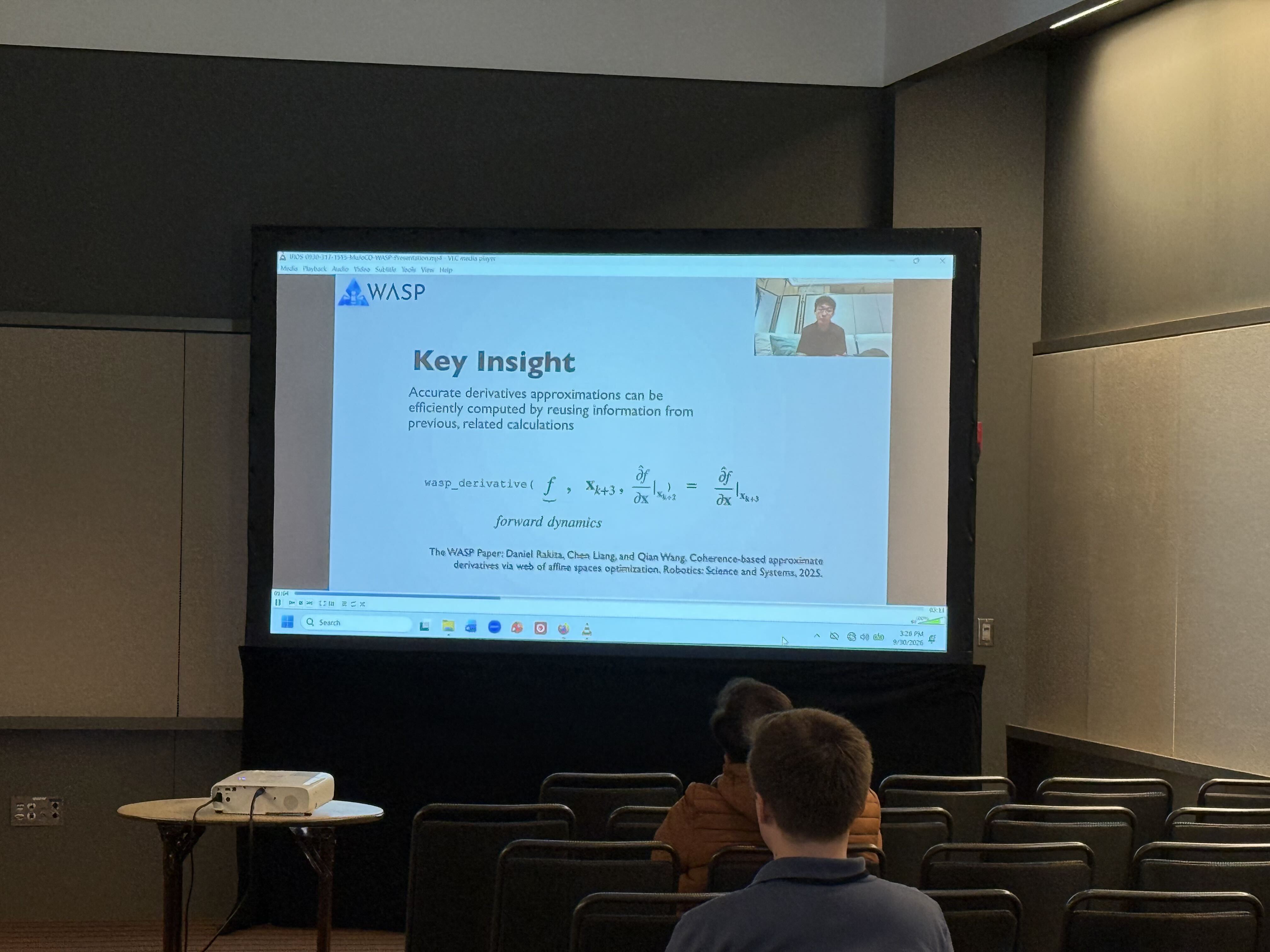
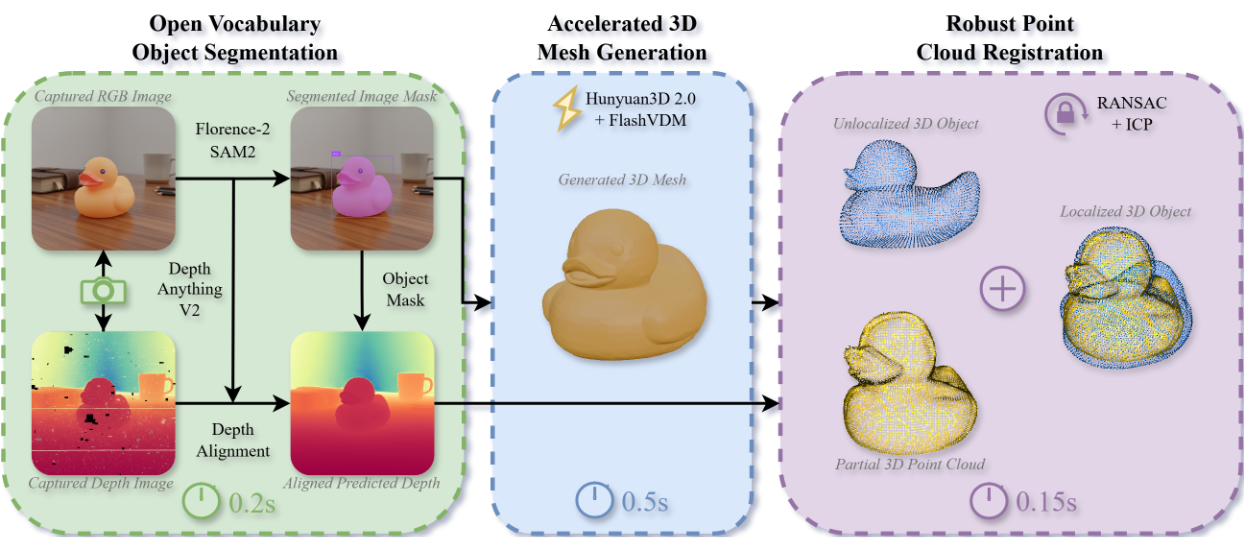
Presenting the key insight behind Web of Affine Spaces derivatives.
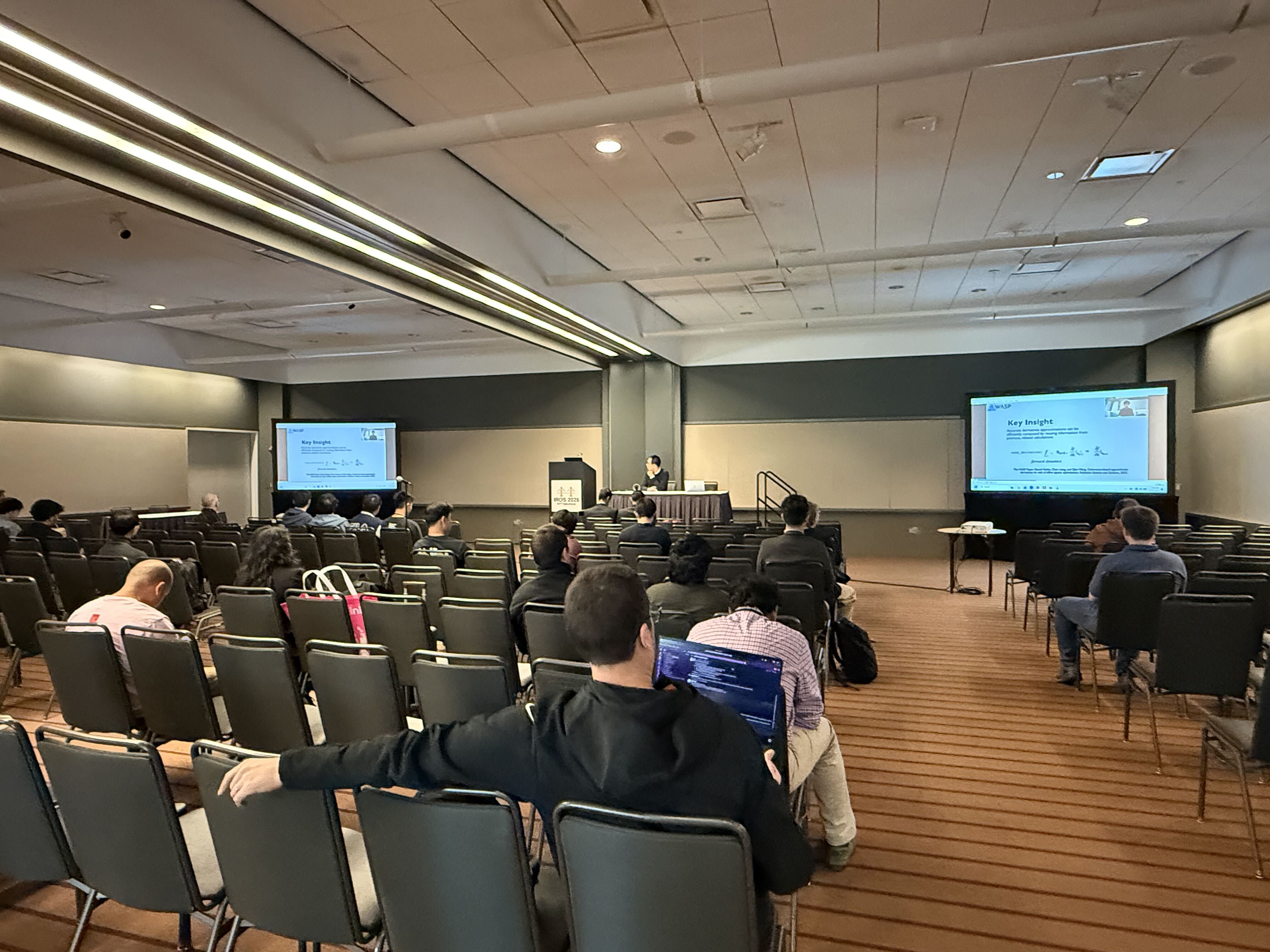
The MuJoCo-based model predictive control presentation at IROS 2026.
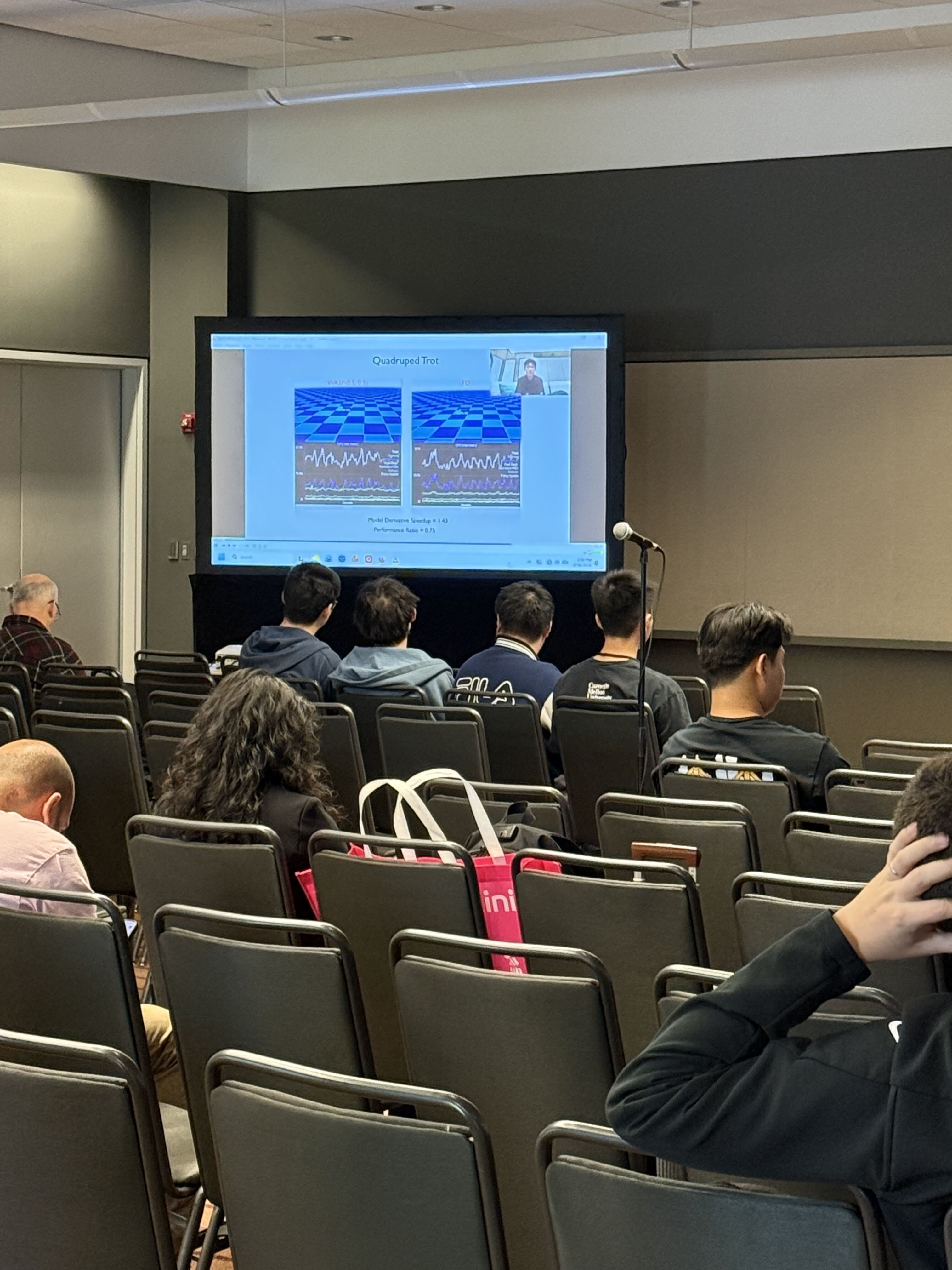
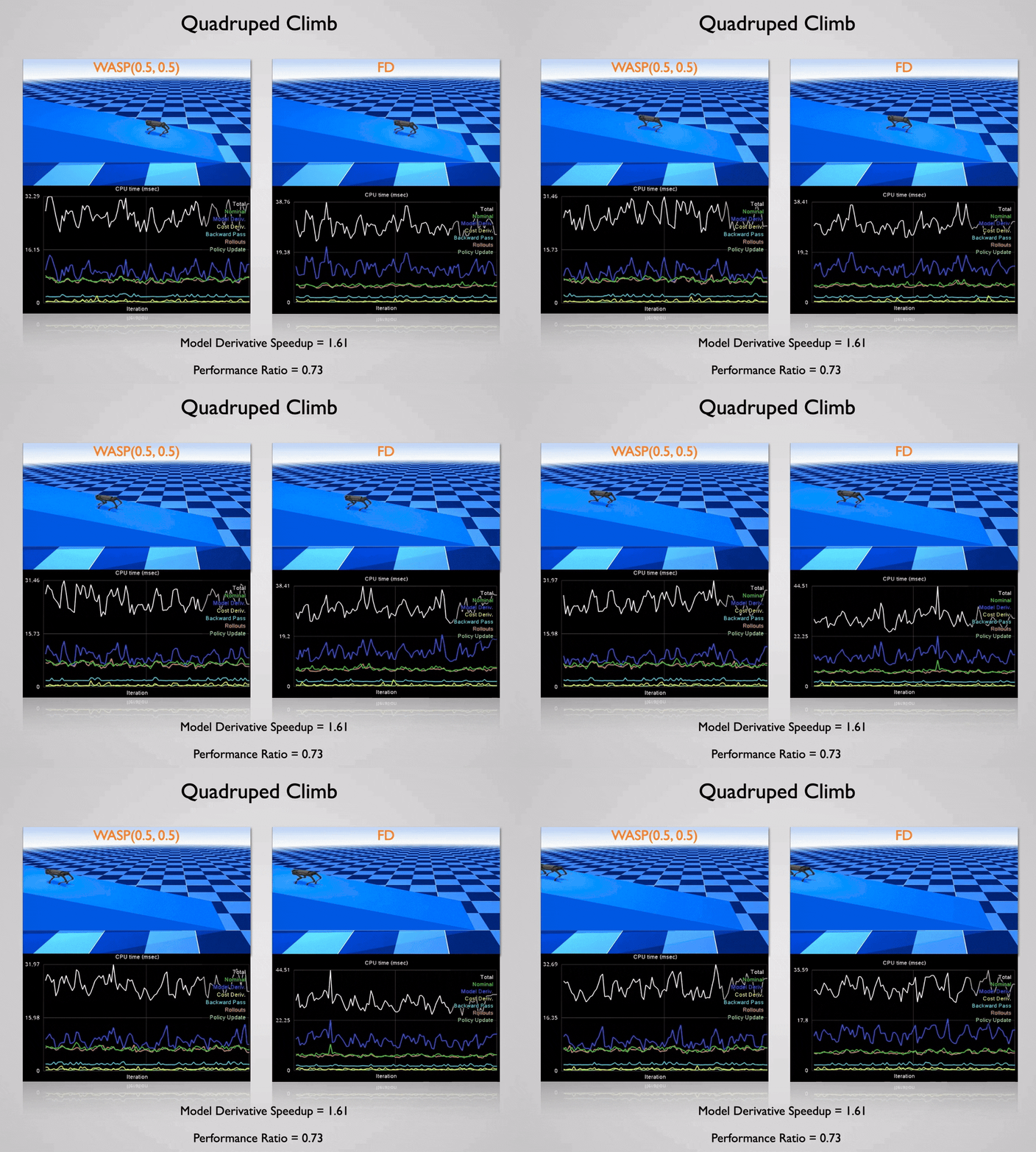
Quadruped locomotion results during the model predictive control presentation.
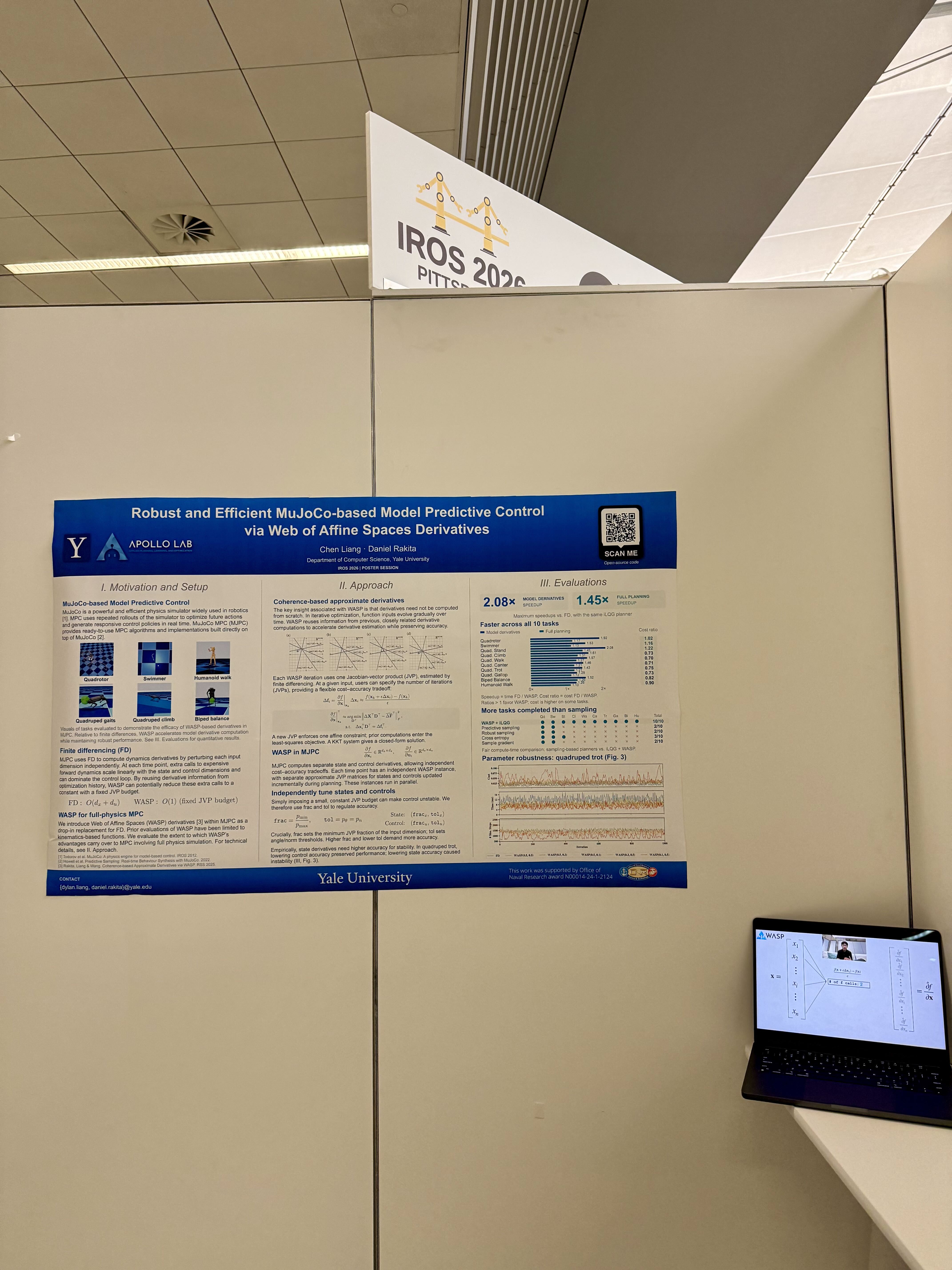
The MuJoCo-based model predictive control poster and demonstration.
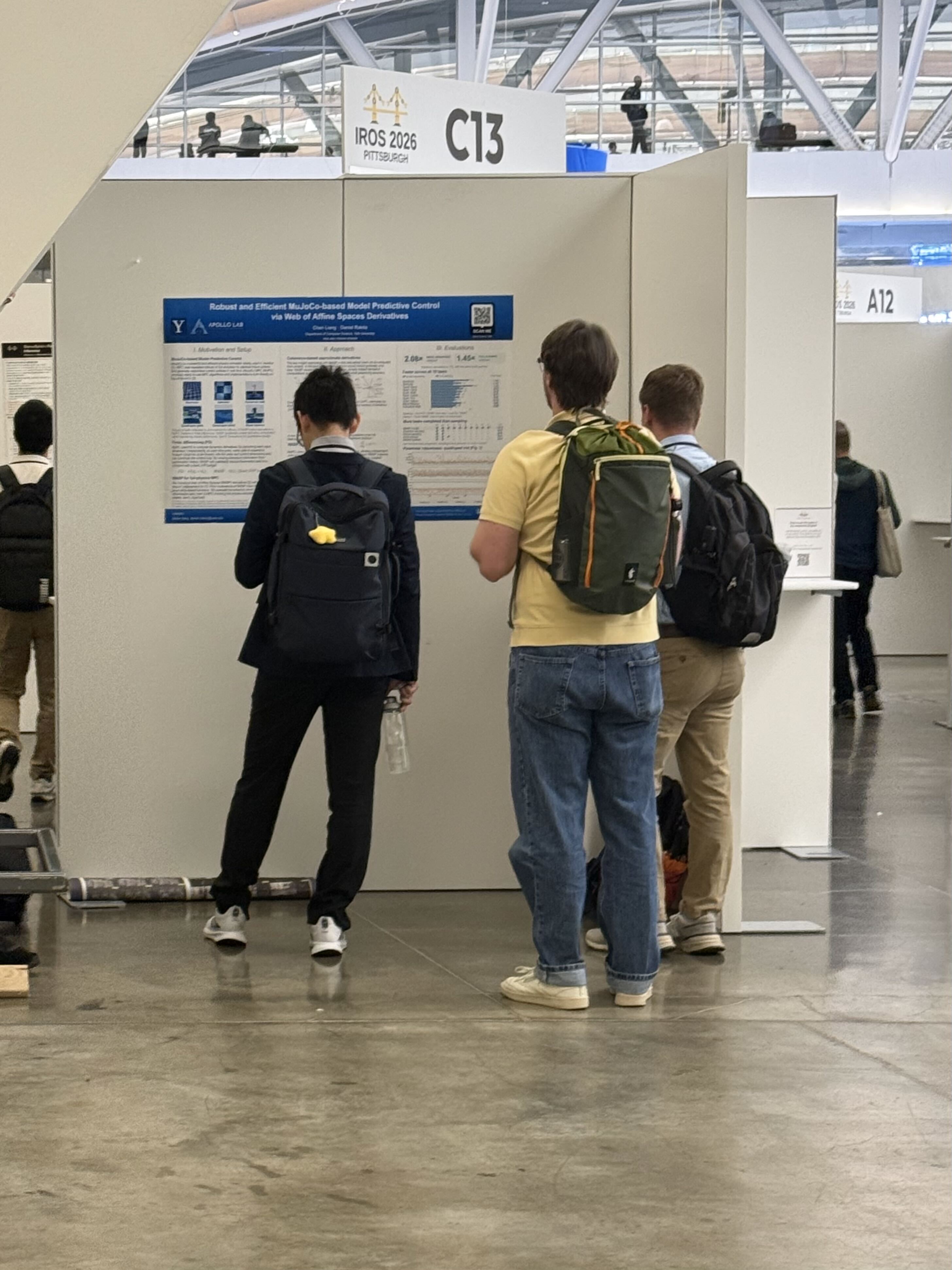
Discussing the model predictive control work during the IROS poster session.
APOLLO Lab shared work on continual learning and model predictive control at IROS 2026.
Award finalist at the LTP workshop
TJ Vitchutripop was an award finalist at the Long-Term Perception for Human-Centric Autonomy (LTP) workshop for our work, An Analysis of Streaming Deep Reinforcement Learning for Adaptive Continual Learning in Robotics.
Authors: Teeratham Vitchutripop, Alyssa Quarles, Wenhe Zhang, Richard Xue, Daniel Rakita.
Model predictive control at IROS
Our work, Robust and Efficient MuJoCo-based Model Predictive Control via Web of Affine Spaces Derivatives, was also presented at the conference.
Authors: Chen Liang, Daniel Rakita.
Paper in collaboration with APOLLO Lab accepted at NeurIPS 2026!
September 25, 2026
RuleSmith: Multi-Agent LLMs for Automated Game Balancing, a paper developed in collaboration with APOLLO Lab, has been accepted at NeurIPS 2026!
Authors: Ziyao Zeng, Hao Wang, Chen Liu, Youheng Yao, Jingcheng Ni, Tianyu Liu, Xiatao Sun, Fengyu Yang, Chenyu You, Xiaofeng Liu, Daniel Rakita, Ronald R. Coifman, Yuval Kluger, Zhiwen Fan.
Two papers accepted at CoRL 2026
September 4, 2026
Two papers have been accepted to CoRL 2026! These papers are:
-
Artificial Foveated Perception for Mitigating Shortcut Learning in Robotic Foundation Models (authors: Xiatao Sun, Yuan Zhuang, Mateo Sanchez Lopez Negrete, Matei-Victor Coldea, Chen Liang, Haoyang Zhang, Che Liu, Ziyao Zeng, Shawn Li, Qian Wang, Fei Miao, Daniel Rakita)
-
Efficient On-policy Visual-RL via Stochastic Decoupled Policy Gradient (authors: Haoxiang You, Yilang Liu, Davis Zong, Qian Wang, Teeratham Vitchutripop, Qi Wang, Daniel Rakita, Ian Abraham)
Paper accepted to the Journal of Robotic Surgery
August 1, 2026
Our paper, AI-Powered Semantic Segmentation Model for Enhanced Ureteral Mapping and Real-Time Instrument Feedback in Robotic Colorectal Surgery (authors: Justin M. Bader, Xiatao Sun, Tripp Rosenfelt, Alexis Ramirez-Hardy, Netanel Sapir, Rachel Scheub, Teeratham Vitchutripop, Amit Khanna, Haddon Pantel, Daniel Rakita) has been accepted for publication in the Journal of Robotic Surgery!